Cyber Insurance for Canadian Businesses
Cyber insurance for Canadian businesses — sometimes called cyber liability insurance — is now a standard part of risk management for organizations that handle data, run on networked systems, or process payments online. It is not a niche product. It is the policy your insurer, your clients, and your board will ask about.
This page explains what cyber insurance is, who needs it in Canada, what affects your eligibility, and how your security posture connects directly to what coverage you can get.
What is cyber insurance for Canadian businesses?
Cyber insurance is a commercial insurance product that protects businesses against the financial consequences of cyberattacks, data breaches, and technology failures. Depending on the policy, it can cover incident response costs, legal defence, regulatory fines, ransomware payments, business interruption losses, and third-party liability claims.
Unlike general commercial insurance, cyber insurance is specifically designed for digital risk. Your property policy does not cover a ransomware attack. Your liability policy does not cover a data breach. Cyber insurance fills that gap.
Who needs cyber insurance in Canada?
Any Canadian business that stores, transmits, or processes personal information, financial records, or proprietary data has cyber exposure. In practice, that includes most businesses operating today.
Cyber insurance is particularly important for businesses that:
- Handle personal information covered under PIPEDA or Quebec’s Law 25
- Process credit card payments or financial transactions
- Rely on cloud systems, SaaS platforms, or remote access tools
- Operate in healthcare, legal, accounting, financial services, or professional services
- Provide technology products or services to other businesses
- Would lose significant revenue if their systems were unavailable for 24–72 hours
Small businesses are not exempt. In Canada, most ransomware attacks target small and mid-sized organizations precisely because they are less likely to have robust security controls or incident response capabilities.
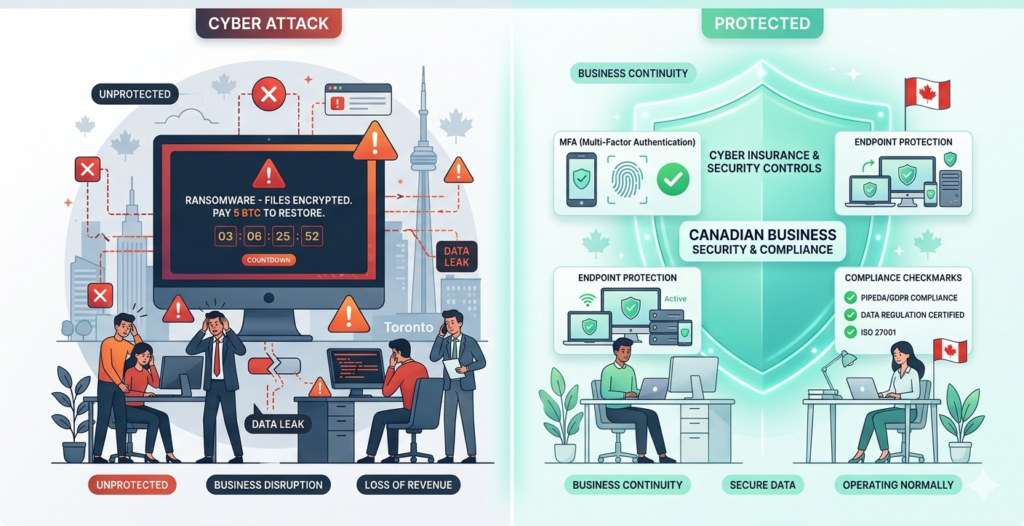
What does cyber insurance typically cover?
Canadian cyber insurance policies generally provide two categories of coverage:
First-party coverage (your own costs)
- Incident response and forensics — cost to investigate the breach, identify the cause, and contain it
- Notification costs — mandatory notification to affected individuals under PIPEDA or provincial law
- Ransomware and extortion payments — coverage for ransom demands, subject to insurer approval and policy conditions
- Business interruption — revenue losses and extra expenses when your systems are offline
- Data restoration — cost to recover or rebuild corrupted or destroyed data
- Crisis communications — PR and reputation management support after a public incident
Third-party coverage (claims against you)
- Network security liability — claims from customers or partners whose systems were affected by a breach originating from yours
- Privacy liability — claims arising from the unauthorized disclosure of personal information
- Regulatory defence and fines — legal defence costs and covered regulatory penalties under PIPEDA, Quebec Law 25, or other applicable legislation
- Media liability — claims arising from digital content, including copyright and defamation in some policies
What affects your cyber insurance eligibility in Canada?
Canadian cyber insurers have tightened their underwriting significantly since 2020. Applications that would have been approved without scrutiny five years ago now face detailed security questions — and some are declined outright.
The factors that most directly affect your eligibility and coverage terms include:
Multi-factor authentication (MFA)
MFA is now a baseline requirement, not a nice-to-have. Most insurers require MFA on email, remote access (VPN, RDP), and privileged accounts. Businesses that cannot confirm MFA deployment may face coverage restrictions or application declines.
Backup and recovery capability
Insurers want to see offline or immutable backups that are tested and stored separately from primary systems. A backup that is connected to your network can be encrypted in a ransomware attack. Insurers know this.
Endpoint protection
Endpoint detection and response (EDR) tools that can detect and contain threats in real time are now expected across most business environments. Basic antivirus is generally no longer sufficient for cyber insurance purposes.
Incident response plan
Insurers ask whether you have a documented incident response plan. A plan does not need to be complex, but it should exist, be tested, and identify who is responsible for what in the event of a breach.
Employee security training
Phishing remains the most common initial attack vector. Insurers increasingly require evidence of annual security awareness training. Some also ask about phishing simulation frequency.
If you want to know whether your current controls are likely to meet insurer requirements, see our detailed guide: Can I Get Cyber Insurance? What Controls You Need to Qualify.
How security evidence affects cyber insurance for Canadian businesses
Cyber insurance applications are largely self-reported. You answer questions about your security controls, and the underwriter uses those answers to set terms, limits, and pricing.
The problem is that self-reported answers are increasingly viewed with scepticism. After a wave of claims where insured businesses overstated their controls, insurers have become more likely to investigate — and, in some cases, to deny claims based on misrepresentation.
Verified security evidence — documentation that demonstrates your controls are actually implemented — changes the quality of your submission. It does not guarantee any particular coverage outcome, but it gives underwriters something concrete to work with rather than a checkbox on a form. That means fewer surprises at renewal and a more defensible position if a claim is ever made.
Cyber insurance and Canadian privacy law
Canadian businesses operating under PIPEDA have a legal obligation to report breaches of security safeguards that pose a real risk of significant harm to individuals. Quebec’s Law 25 (Bill 64) adds additional requirements, including stricter rules around consent, data minimization, and breach notification timelines.
Cyber insurance can help cover the cost of mandatory notification and regulatory response. But the policy will not protect you if you cannot demonstrate that you had reasonable security measures in place before the incident. Insurance and security are complementary — not substitutes for each other.
See your security posture before your next renewal
Readiness AI generates a verified security evidence report you can share with your broker or include with your next cyber insurance application or renewal.
Frequently asked questions
Is cyber insurance mandatory in Canada?
Cyber insurance is not legally mandated in Canada, but it is increasingly required by contract. Many enterprise clients, government vendors, and regulated industries now require proof of cyber insurance as a condition of doing business. Even where it is not required, the financial exposure from a breach makes it a standard operational consideration for any business handling personal data.
How much does cyber insurance cost in Canada?
Premiums vary based on revenue, industry, number of records held, and the strength of your security controls. Small businesses with straightforward operations and good security hygiene can often access coverage in the range of a few thousand dollars per year. Businesses in higher-risk industries or with weaker controls will pay more — or face limited coverage options. Rates have increased materially since 2020 as claims frequency has risen.
What is the difference between cyber insurance and general liability?
General liability insurance covers physical injuries and property damage. It does not cover data breaches, ransomware attacks, or the costs of notifying affected individuals. Cyber insurance is purpose-built for digital risk. Some older general liability policies contain cyber exclusions explicitly — check your existing coverage before assuming you are protected.
Can I get cyber insurance if I use third-party cloud services?
Yes, but cloud usage affects what is covered. Most policies exclude losses caused directly by cloud provider outages (infrastructure you do not own or control). Your cyber policy covers your data and your business processes — not the cloud provider’s failure. If cloud availability is critical to your operations, review your policy’s system failure and contingent business interruption provisions carefully.
Will my cyber insurance cover a ransomware attack?
Most cyber policies include ransomware coverage, but conditions apply. Insurers typically require that the attack is reported promptly, that you have followed reasonable security practices, and in some cases that you obtain pre-approval before making any payment. Policies may also have sub-limits on ransomware that are lower than the overall policy limit. Read the extortion provisions carefully.
How do I know if my cyber insurance application is accurate?
Accuracy on a cyber insurance application matters — misrepresentation can result in a denied claim. The most defensible approach is to base your answers on verified security evidence: documentation that confirms your controls are actually in place and functioning. A security assessment before you apply gives you a factual baseline and reduces the risk of gaps between what you report and what is real.