Cyber Control Verification for Canadian SMBs
Cyber control verification is the process of documenting and confirming that your cybersecurity controls are implemented, configured, and functioning — with evidence that can be reviewed by a cyber insurer, an enterprise client, or a compliance auditor. For Canadian SMBs, the ability to produce verified cyber control evidence has become a practical business requirement: it affects whether you can get cyber insurance, whether you can win contracts with larger organizations, and whether you can demonstrate compliance under Canadian privacy law.
Readiness AI helps Canadian SMBs build and maintain cyber control evidence that is structured, current, and ready to present when it matters most.
What Is Cyber Control Verification?
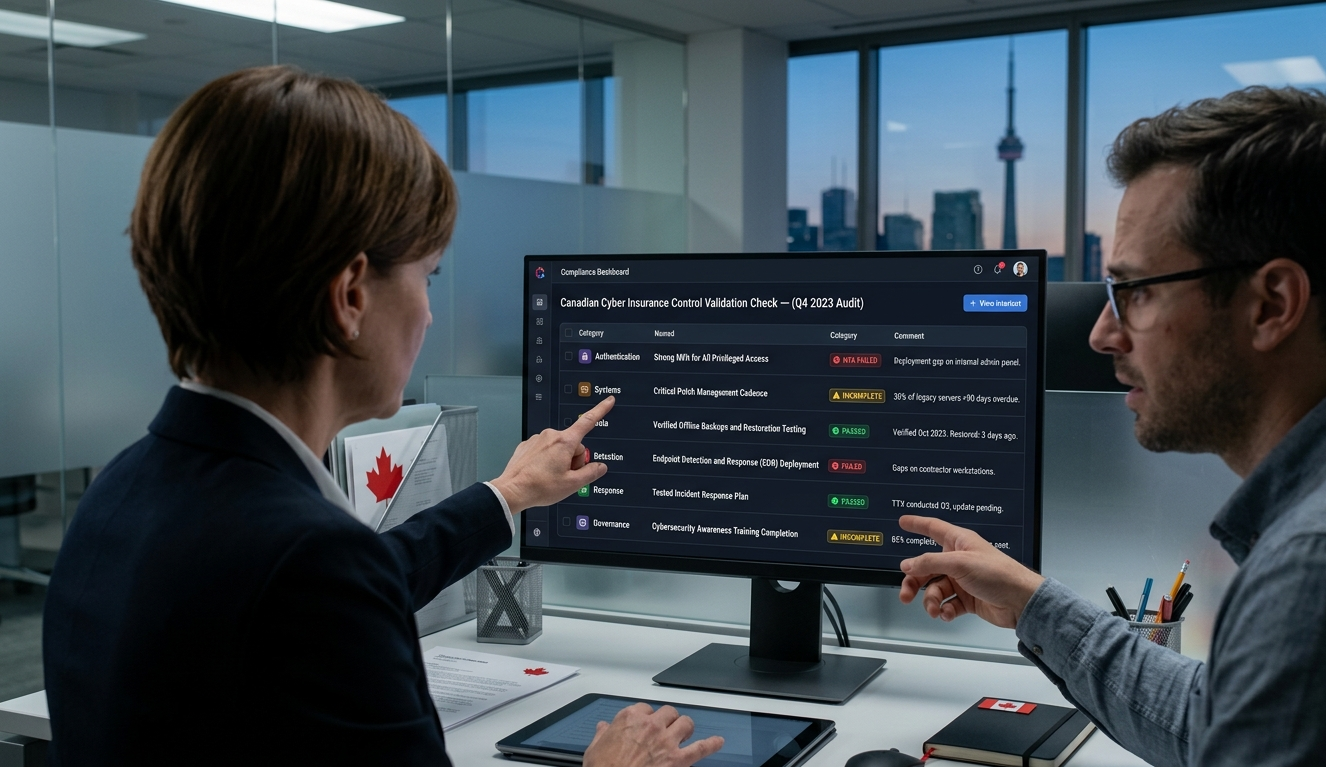
Cyber control verification is the practice of confirming — with documented evidence — that your cybersecurity safeguards are in place and working. It is distinct from simply having a security policy or claiming that a control exists. Verification means you can show a screenshot, a configuration export, an audit log, a completion record, or a vendor report that demonstrates the control is active.
The term is used across insurance underwriting, vendor security assessments, and compliance frameworks. When a cyber insurer asks whether you have MFA enforced, they want verified evidence — not a yes-or-no answer. When an enterprise client sends a security questionnaire, they want control evidence they can review and retain. Cyber control verification is the process that produces that evidence.
Why Canadian SMBs Need Cyber Control Verification
The Canadian cyber insurance market has hardened significantly. Following large ransomware losses in 2021 and 2022, insurers including Intact, Aviva, Northbridge, Travelers, and Chubb tightened their underwriting requirements. Today, cyber insurance applications and renewals routinely require verified evidence of specific controls — not just attestations. SMBs that cannot produce this evidence face coverage declines, coverage gaps, higher premiums, or sublimits that leave them exposed.
Client-side pressure has grown in parallel. Enterprise organizations in healthcare, financial services, legal, and government are requiring their vendors and suppliers to demonstrate cybersecurity controls as part of third-party risk management programs. For SMBs that sell to or work with regulated organizations, the ability to respond to a vendor security assessment with verified control evidence has become a condition of doing business.
Canadian privacy law creates a third driver. PIPEDA requires organizations to protect personal information with appropriate security safeguards. Quebec’s Law 25 sets more prescriptive requirements and imposes significant penalties for non-compliance. Provincial health privacy laws in Ontario, Alberta, and British Columbia impose their own requirements. Cyber control verification provides the documented evidence needed to demonstrate that your organization meets its legal security obligations.
Key Cyber Controls That Require Verification
These are the cyber controls most commonly required by Canadian insurers, enterprise clients, and compliance frameworks — and the types of evidence that verify each one:
Multi-Factor Authentication
MFA is required on all remote access systems including email platforms, VPNs, remote desktop environments, and cloud applications. Verification evidence includes conditional access policy exports, identity provider screenshots, or a configuration report showing MFA enforcement across all in-scope systems. Partial MFA deployment — covering email but not VPN, for example — is a common gap that affects underwriting outcomes.
Endpoint Detection and Response
EDR solutions detect and respond to threats at the device level. Verification evidence includes a deployment coverage report showing the percentage of endpoints protected, the name of the EDR solution, and confirmation that real-time monitoring is active. Insurers now routinely distinguish between legacy antivirus software and true EDR platforms with behavioural detection and response capabilities.
Backup and Recovery
Backup verification requires evidence of the backup frequency, retention schedule, offsite or cloud storage location, and restoration testing. Immutable backups — which cannot be encrypted or deleted by ransomware — are now considered a baseline requirement by most cyber insurers. Verification evidence includes backup software reports, cloud storage configuration exports, and records of successful restoration tests.
Access Control and Least Privilege
Access control verification requires evidence that users have only the access they need for their role, that administrative privileges are limited and monitored, and that access is reviewed and revoked promptly when employees leave or change roles. Evidence types include access control logs, user role reports, offboarding checklists, and privileged access review records.
Security Awareness Training
Training verification requires completion records for all staff, documentation of training content and frequency, and — increasingly — phishing simulation results. Insurers typically require training to be completed within the past 12 months. Evidence must show that training is organization-wide, not limited to IT staff.
Vulnerability and Patch Management
Patch management verification requires evidence of a regular patching cycle, current patch status across servers and workstations, and a defined process for prioritizing critical patches. Vulnerability scan reports, patch management console exports, and patching policy documentation are common evidence formats. Outstanding critical vulnerabilities are a frequent source of underwriting concern.
Incident Response Readiness
Incident response verification requires a documented plan covering detection, containment, notification, and recovery steps. Evidence of plan testing through tabletop exercises is increasingly required. Insurers want to see that key personnel know their roles and that the plan addresses ransomware and data breach scenarios specifically.
The Cyber Control Verification Process with Readiness AI
Readiness AI provides a structured process for cyber control verification designed specifically for Canadian SMBs. The process begins with a readiness review that maps your current control posture against the requirements of Canadian cyber insurers, major compliance frameworks, and common client security assessment templates.
Based on the review, we identify which controls are verified, which have gaps, and which require evidence collection. We then guide you through the evidence collection process — working with your IT team or MSP to gather screenshots, configuration exports, logs, and reports that document each control. The result is a structured evidence package that can be presented to your insurer at renewal, shared with enterprise clients responding to security questionnaires, or retained as compliance documentation.
Ongoing maintenance is built into the Readiness AI model. As your environment changes, as controls are updated, and as new requirements emerge from insurers or clients, we help you keep your control evidence current. This means you are not scrambling to pull together documentation at renewal time — your evidence is maintained throughout the policy year.
Cyber Control Verification Frameworks: NIST CSF and CIS Controls
Canadian cyber insurers and enterprise clients frequently reference NIST CSF and CIS Controls when specifying their control requirements. Understanding these frameworks helps SMBs connect their control evidence to the language underwriters and clients use.
The NIST Cybersecurity Framework organizes controls across five functions: Identify, Protect, Detect, Respond, and Recover. Readiness AI maps your verified controls to the NIST CSF functions so you can clearly articulate your security posture in terms insurers and enterprise clients recognize.
CIS Controls provides an implementation-focused list of security actions prioritized by their effectiveness against real-world threats. The first six CIS Controls — covering asset inventory, software inventory, data protection, secure configuration, account management, and access control management — are the foundation of most insurer control requirements. Readiness AI aligns your evidence collection to CIS Control priorities so your verification work maps directly to underwriting requirements.
Frequently Asked Questions About Cyber Control Verification
What is the difference between cyber control verification and a penetration test?
A penetration test actively probes your systems for vulnerabilities and exploitable weaknesses. Cyber control verification documents that your controls are configured and operational. Both are useful, but they serve different purposes. Insurers and clients asking for control verification are not asking you to commission a penetration test — they want documented evidence that specific safeguards are in place. Readiness AI focuses on control evidence, not penetration testing.
How often should cyber control verification be updated?
Control evidence should be updated whenever a significant change occurs in your environment — a new system deployed, a vendor relationship changed, staff turnover in IT roles — and at a minimum on an annual basis aligned with your insurance renewal cycle. Readiness AI helps you maintain evidence continuously rather than updating it only when a deadline forces the issue.
Can verified controls lower my cyber insurance premium?
Yes. Insurers price risk based on the controls you have in place. SMBs with verified, comprehensive controls qualify for lower premiums, broader coverage, and fewer exclusions than businesses that cannot demonstrate their security posture. In some cases, verified controls are the difference between being offered coverage at all and being declined. Readiness AI helps you build the control evidence that supports the best possible underwriting outcome.
What if my business uses a managed service provider for IT?
MSPs are a common IT delivery model for Canadian SMBs, and Readiness AI is designed to work alongside MSP relationships. We help you understand what control evidence your MSP can provide, what questions to ask them, and how to collect and organize the evidence they produce. In many cases, MSPs have reporting and documentation capabilities that are not being used to their full potential for insurance and client evidence purposes.
Start Your Cyber Control Verification
Whether you are approaching a cyber insurance renewal, responding to a client security questionnaire, or working toward compliance with Canadian privacy law, cyber control verification is the foundation. Readiness AI provides the structure, guidance, and evidence framework you need to get verified and stay verified.
Start your readiness review and find out exactly which controls need verification and what evidence you need to collect.