Security Control Verification for Canadian SMBs
Security control verification is the process of confirming that your cybersecurity controls are actually working — not just documented. For Canadian small and mid-sized businesses (SMBs), verified security controls are increasingly required by cyber insurers, enterprise clients, and regulators. Without evidence that your controls work, your insurance application may be declined, your renewal premium may spike, or a client security questionnaire may stall a contract.
Readiness AI helps Canadian SMBs build structured, verifiable control evidence that satisfies cyber insurance underwriters, client procurement teams, and compliance frameworks including NIST Cybersecurity Framework (NIST CSF) and CIS Critical Security Controls.
What Is Security Control Verification?
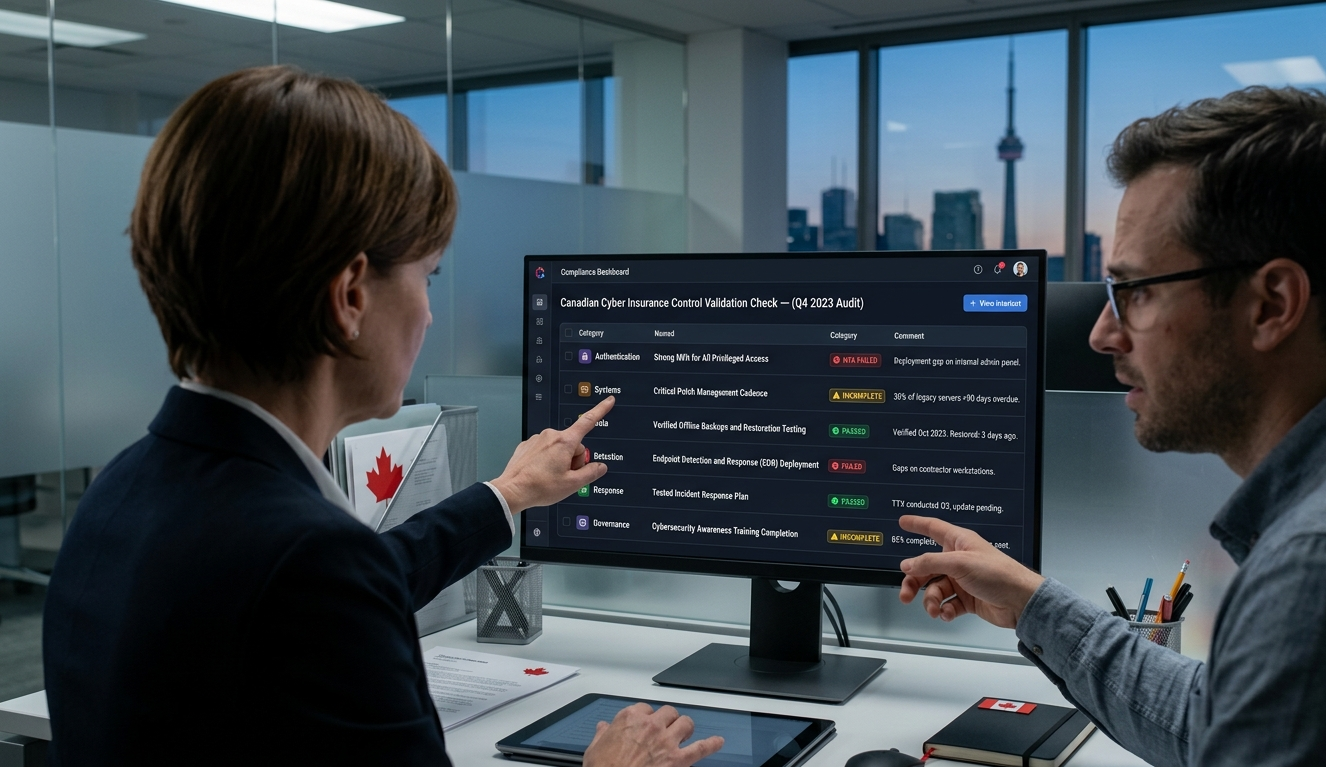
Security control verification means gathering and organizing documented proof that your cybersecurity safeguards are configured, active, and functioning as intended. It goes beyond a policy document or a checkbox on a form. Insurers and enterprise clients now require evidence — screenshots, configuration exports, audit logs, vendor reports — that your controls are real and operational.
The controls most commonly verified during insurance underwriting and client security reviews include multi-factor authentication (MFA), endpoint detection and response (EDR), offsite and immutable backups, privileged access management, employee security awareness training, and incident response planning. Each control requires a different type of evidence, and the standard for what counts as “verified” has tightened significantly since 2023.
Why Security Control Verification Matters for Canadian Businesses
Canadian cyber insurers have raised their minimum control requirements following a surge in ransomware claims. Underwriters at major carriers including Intact, Aviva, Northbridge, and Travelers Canada now require verified evidence of specific controls before binding coverage. A policy document or verbal confirmation is no longer sufficient — underwriters want exportable, timestamped proof.
Beyond insurance, enterprise clients and regulated-industry procurement teams routinely send security questionnaires that require detailed control evidence. Healthcare organizations, financial institutions, and government contractors increasingly impose cybersecurity requirements on vendors as a condition of doing business. For SMBs, failing to provide verified control evidence can mean lost contracts and stalled RFPs.
Canadian privacy law adds a third dimension. Organizations subject to PIPEDA, Quebec Law 25, or provincial health privacy legislation must demonstrate that reasonable security safeguards are in place. Security control verification provides the documented evidence needed to show regulators — and courts — that your organization took its security obligations seriously.
The 7 Security Controls Canadian Insurers Verify Most Often
Based on current underwriting requirements across the Canadian cyber insurance market, these are the controls most commonly subject to verification during the application and renewal process:
1. Multi-Factor Authentication (MFA)
MFA verification requires evidence that MFA is enforced across email (especially Microsoft 365 or Google Workspace), VPN access, remote desktop connections, and privileged administrative accounts. Screenshots from your identity provider or conditional access policy exports are typically required. Underwriters want to see MFA applied to all remote access points, not just email.
2. Endpoint Detection and Response (EDR)
EDR verification requires proof that endpoint protection is deployed across all devices — not just servers. Evidence typically includes a deployment report from your EDR platform showing coverage percentage and active monitoring status. Many underwriters now distinguish between basic antivirus and true EDR, and only count verified EDR deployments toward your control score.
3. Offsite and Immutable Backups
Backup verification requires evidence of the backup schedule, retention period, offsite storage location, and a documented and tested restoration process. Immutable backups that cannot be modified or deleted by ransomware are increasingly required. Evidence includes backup software reports, cloud storage configuration screenshots, and test restoration records.
4. Privileged Access Management
Privileged access verification requires evidence that administrative credentials are controlled, monitored, and rotated. This includes documentation showing the number of privileged accounts, access review logs, and whether just-in-time access or a privileged access workstation model is in use. Underwriters look for evidence that standing administrative access is limited and that privilege escalation is audited.
5. Security Awareness Training
Training verification requires completion records showing which employees completed security awareness training, when it was completed, and what topics were covered. Phishing simulation results are increasingly requested as supplementary evidence. Underwriters want to see training completed within the last 12 months and evidence of a recurring training schedule.
6. Incident Response Plan
Incident response verification requires a documented plan that identifies key roles, escalation paths, communication procedures, and containment steps. Underwriters increasingly ask whether the plan has been tested through a tabletop exercise. A plan that exists only as a PDF with no evidence of review or testing may not satisfy current underwriting requirements.
7. Patch Management and Vulnerability Management
Patch management verification requires evidence of a consistent patching schedule, current patch status across endpoints and servers, and a process for prioritizing critical vulnerabilities. Vulnerability scan reports, patch management dashboard exports, and documented patching policies are the typical evidence types. Critical vulnerabilities outstanding for more than 30 days are a common underwriting concern.
How Readiness AI Helps with Security Control Verification
Readiness AI is a cyber readiness evidence platform built for Canadian SMBs. We help you identify which controls need verification, collect the right type of evidence for each control, and organize it into a structured format that satisfies insurance underwriters, client security reviewers, and compliance frameworks.
Our onboarding process starts with a readiness review that maps your current control posture against the requirements used by Canadian cyber insurers and enterprise clients. We identify gaps before your insurer does, giving you time to address deficiencies before your renewal or a client questionnaire arrives. The result is a control evidence package that documents your security posture clearly and completely.
For businesses undergoing their first formal control verification, Readiness AI provides guidance on what evidence to collect, which formats are accepted by underwriters, and how to present your security posture in a way that supports favourable underwriting outcomes. For businesses that have been through the process before, we help maintain and update evidence on an ongoing basis so you are always renewal-ready.
Security Control Verification vs. Security Audit: What Is the Difference?
A security audit is a formal, often third-party assessment of your security program against a defined standard. Security control verification is a targeted, evidence-based process of confirming that specific controls are in place and functioning. For most Canadian SMBs, a full security audit is expensive and time-consuming — and not what insurers or clients are actually asking for. What they want is verified evidence of specific controls, organized in a format they can review efficiently.
Security control verification fills the gap between a paper policy and a full audit. It is practical, focused on the controls that matter most to your specific audience — insurer, client, or regulator — and produces evidence that can be updated and reused across multiple use cases.
Frequently Asked Questions About Security Control Verification
How long does security control verification take?
For most SMBs working with Readiness AI, the initial control verification process takes two to four weeks. This includes identifying which controls require evidence, collecting the evidence from your existing tools and vendors, and organizing it into a structured package. Businesses with significant control gaps may require additional time to remediate before evidence collection is complete.
Do I need a dedicated IT team to verify my security controls?
No. Many of our clients are SMBs with a single IT generalist or an outsourced managed service provider. Readiness AI is designed to work alongside your existing IT support. We provide guidance on what to request from your IT provider and how to collect evidence from tools you already use.
What happens if I have gaps in my security controls?
Gaps are common and addressable. Readiness AI identifies control gaps early so you have time to remediate before your insurance renewal or a client security review. In some cases, compensating controls or documented remediation plans can satisfy underwriter requirements even when a control is not yet fully implemented. We help you understand your options and prioritize the highest-impact improvements.
Is security control verification the same as compliance?
Security control verification and compliance overlap but are not identical. Compliance frameworks like SOC 2, ISO 27001, and NIST CSF define controls that should be in place. Verification is the process of confirming those controls are actually implemented and functioning. For most Canadian SMBs, the immediate business need is not formal certification but verified evidence that satisfies insurers and clients — which is exactly what Readiness AI provides.
For further reading on the standards that govern security control verification, the NIST Cybersecurity Framework and CIS Critical Security Controls are the primary references used by Canadian cyber insurers and enterprise security teams when evaluating SMB control evidence.
Start Your Security Control Verification
If you have an insurance renewal coming up, a client security questionnaire to respond to, or a compliance requirement to meet, security control verification is the starting point. Readiness AI helps Canadian SMBs get verified, stay verified, and demonstrate their security posture with confidence.
Start your readiness review to see how your current controls measure up and what evidence you need to collect.